Showing posts with label #hygiene. Show all posts

Monday, 13 November 2017

Water of Life: India’s step towards eradicating water-borne diseases


With rapid urbanization of India, as well as a steadily increasing population, there is a tremendous pressure on the Indian government to provide safe drinking water and sanitary services to more than 266 million who are living in towns and cities. The health conditions that are associated with lack of safe drinking water and sanitation are reflected in high rates of stunting, malnutrition, and death from water-borne diseases. Most of the water-borne diseases are caused by poor sanitation practices, as nearly half of India’s 1.2 billion people have no toilet at home and 44% of the mothers disposing their children’s feces in the open. According to The World Bank, 21% of the India’s communicable diseases are water-borne, and children under the age of 5 are particularly vulnerable.
The WASH campaign by the UNICEF is one of the key steps through which interdependent issues of water, sanitation and hygiene were addressed. Additionally, Swacch Bharat Mission (Clean India Campaign) was initiated by the USAID and India jointly on January 13th, 2015 where USAID signed a Memorandum of Understanding (MOU) with the Ministry of Urban Development to contribute to realization of India’s vision of availability of clean water and sanitation for all. The plan includes:
1. developing monitoring and evaluation framework to support program implementation
2. facilitate capacity building
3. develop communication strategies between different government and private institutions


Additionally, urban WASH Alliance is being set up that will allow a platform for India’s public and private sectors to implement and scale innovative water and sanitation projects and campaigns in India’s major cities in Bangalore, Ahmedabad, Delhi, Chennai, Kolkata, and Hyderabad. In the Delhi area, USAID and Government of Delhi are working in underserved areas to provide water and sanitation infrastructures. The aim is to reach more than 40,000 households in approximately 60 slums, with setup of 4,000 individual toilets and safe drinking water for 10,000 households.

Our organization, Heeals, has been at the forefront of implementing hygiene programs in underserved communities. It works with schools and underserved communities to bring about changes in attitude and knowledge towards these issues, that are often a matter of taboo especially among the females. Further Heeals helps to bring resources such as soaps, building safe places for defecation, and working with local authorities in bring clean water in these communities.

-Payel
Volunteer


Tuesday, 21 February 2017

First Experience In A Rural Village In Western Uttar Pradesh

FIRST EXPERIENCE IN A RURAL VILLAGE IN WESTERN UTTAR PRADESH

ARE THEY DRINKING SAFE WATER?

First day of internship at Heeals (NGO, Gurgaon, India), first day in rural India. The three and a half hours car trip doesn’t reflect at all the small distance on the map, from Gurgaon to Greater Noida. We just passed through a congested and noisy Monday morning Delhi, and after a while the landscape changes… Just passed through a tollbooth like if it was a time machine, which has zapped us in a new dimension, where nature and silence permeate everything. Lush green fields replacing polluted and dirty streets, no more cars, just shouting children, cows and sometimes a bullock cart. How could it be possible?

We arrive at the village school and a group of 30 children, from 6 to 13 years old appears at the window grates, shy but still very excited. They are shouting “mam” (madam), trying to catch our attention, they want to know who we are and where are we coming from. First worried about how to approach to them, mostly for the linguistic barrier, we start to communicate with them thanks to our tutor and colleague Hindi translation and trough hand gestures. But the best way to break the ice is to play with them, and through our smiles, it is the easiest way to communicate with each other!
A couple of girls want us to see the new toilets that have been recently built outside the school. One proud and brave student takes me by the hand to take a look of the restrooms. They are pretty new, but not clean and there are no sinks to clean their hand or to drink some water.                                       
Next to the school there is a new hand pump, which has been built just 2/3 months ago, and which provides water for all purposes: to wash their hands, to clean toilets, but even used as drinking water. Having access to water near to the school already seems like a huge step for them, since before they had to take it from the village temple, but still this water has not been tested and is not safe to drink.
On the opposite field from the school, very close by, approximately 12 meters from the hand pump, there is a polluted pond with stagnant green water and insects floating on the surface. It's no great stretch to imagine that it is the same water that is provided to the pupils trough the hand pump, since the groundwater are more likely to be contaminated by the pond. 
Having access to safe drinking water should no more be seen as a service or as a commodity, but as a basic human right, that everyone should benefit from. The United Nations’ Human Right statement on right to water says “The human right to water entitles everyone to sufficient, safe, acceptable, physically accessible and affordable water for personal and domestic uses. An adequate amount of safe water is necessary to prevent death from dehydration, reduce the risk of water-related diseases and it is provided for consumption, cooking, personal and domestic hygienic requirements”.


Even though the access to improved sources of drinking water is increasing, still in 2008, 884 millions of people, especially from developing regions, were not able to have access to safe or unimproved-sources water. Moreover we should point out the disparities between urban and rural areas. Indeed while 94% of developing regions urban citizens have access to improved sources water, it is only 76% of rural population who can benefit from this basic need and the increase in the use of improved drinking-water sources is barely keeping with the massive city population growth.  
In India the right to safe drinking water is part of the right to life, which is contained in Article 21 of the Constitution. The 10t Five Year Plan (2002-2007) tried to cover urban areas basic needs, efficient operation and equitable distribution of water. Unfortunately, even in spite of the importance given to drinking water improvement, still 480 million of Indian citizens at that time hadn’t got access to safe drinking water, and India was ranked 133rd among 180 countries in regards to poor water availability.
Governments and local authorities should take care about this actively and provide primary basic human needs, such as access to clean drinking water, clean toilets and infrastructures where children can play.


Heeals Intern

Source: 
UNICEF, World Health Organization, Progress on Sanitation and Drinking Water, 2010 update, p. 7.
YOJANA, WATER, September 2007, p. 10, “The India Water Portal”, Rohini Nilekani, Chairperson, Arghyam, Akshara Foundation (Bangalore), Pratham.

Sunday, 31 January 2016

Water Sanitation Hygiene ( Menstrual Hygiene) Campagin.

Water Sanitation Hygiene ( Menstrual Hygiene) Campaign And Distribution Of WASH And Education Materials In Schools Of Bhatipura Village ,Meerut, Khora And Noida .
Campaign Supported By Soap Box , Mika And Sarah .
Campaign Coordinator : Richa ,Sonika & Amy

Picture Gallery Link: https://www.facebook.com/media/set/?set=a.961267310621748.1073741876.287634107985075&type=3


 Come Join Us Our Projects And Be A Part Of Change 

Website : http://heeals.org/
Twitter : http://www.twitter.com/heeals.

Tuesday, 22 December 2015

WASH in Schools: Fundraising Event For A Cleaner, Healthier India Spread Support Share

Click below link to visit the page:
https://www.generosity.com/community-fundraising/wash-in-schools-for-a-cleaner-healthier-india


PHOTO: Clean water should be a right for everyone in India      

Take a moment and think about washing your hands. Think about getting a glass of water, flushing the toilet, taking a shower, brushing your teeth… These are all things that most of us consider pretty essential to maintaining good personal hygiene, right? 

Now imagine that you were born into different circumstances. 
Imagine that the only water you had was brownish, muddy groundwater that made you ill when you drank it.
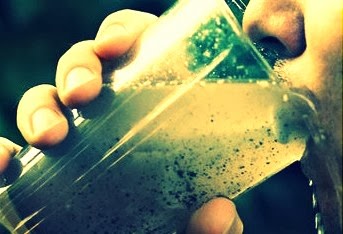
Imagine there was no way of washing your hands before eating except by rinsing them in that same infected muddy water; imagine that instead of a toilet, you just had to pick a spot in a patch of wasteland and hope that no venomous animals (or people) decided to rudely interrupt your business.

This is what life is like for millions of people in India’s most marginalised communities every single day. But with your help, we can change this.
In India, diarrhoea alone causes more than 1,600 deaths every 24 hours. At the root of this, more often than not, are unsafe water, sanitation and hygiene (WASH) practices and facilities.

Our solution to this unfortunate situation is our WASH in Schools Project, a small-scale, grassroots campaign with that will have a big impact. A pilot program has been initiated in a few schools to test it and the reaction and feedback has been outstanding. But funding is now crucial to continue this amazing work.

This project will focus on four schools: two located in rural villages, and two in marginalised communities within the city (slums).
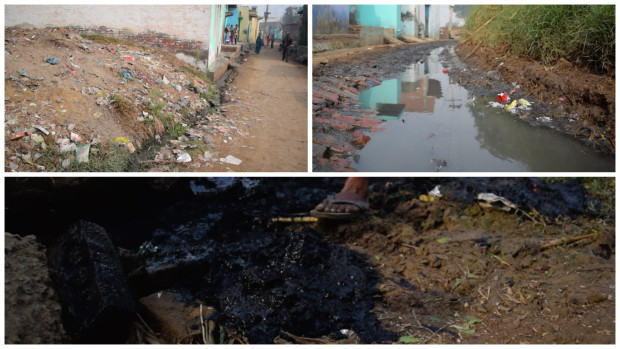
PHOTO: Open sewers and rubbish dumps are a common sight in rural areas and slums

It aims to:
a) Raise awareness around safe hygiene practices through workshops and other educational activities. This will involve first educating children about routine hygiene measures (hand-washing, drinking filtered water…) and how these can be implemented as a part of their everyday lives (boiling water before use, homemade water filters, how to find and use naturally-occurring disinfectants…). As well as this, we will hold specific focus groups on menstrual hygiene as this is often a problematic area for women, especially young girls (see below). The hope and part of the process is to take this learning back home to their families to help educate them too.

b) Distribute sanitation kits and supplies to the students. These include essentials such as soap, sanitary pads, hand sanitiser, toothbrushes and mosquito coils. Depending on funding and your support, some or all will also contain stationery (pen, pencil, sharpener, eraser, notebook...). In addition to this, we aim to provide each school with at least one non-electric water purifier, to allow children access to safe drinking water during school hours. We can only achieve this with your help.

A recurring theme throughout the project will be menstrual hygiene and the importance of education for girls. Our aim is to help girls complete their education in the best possibleconditions by informing and educating them and their families on their needs (hygienic and otherwise) and rights, whilst enabling girls to blossom and grow into empowered members of India's society.
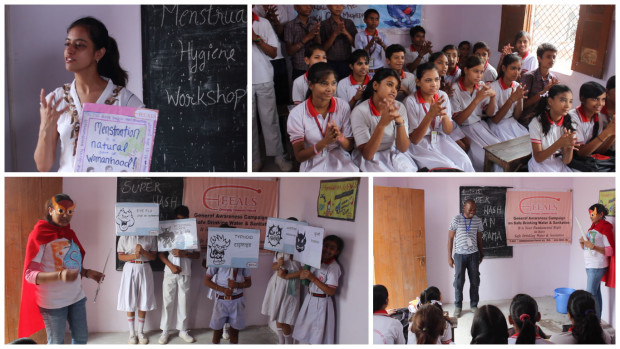
PHOTO: Some activities and workshops

REWARDS
                          ♥ ♥ ♥ ♥ ♥ ♥ ♥ ♥ ♥ ♥ ♥ ♥ ♥ ♥ ♥ ♥ ♥ ♥ ♥ ♥ ♥ ♥ ♥ ♥ ♥ ♥ ♥ ♥ ♥ ♥ ♥ ♥ ♥ ♥ ♥ ♥ ♥
As you may have noticed, the rewards we offer won’t physically go to the donor (other than a huge thank you on our site and facebook page and an  e-greetings card, because you definitely deserve something). This is because we feel that our resources will be better spent on the people we are reaching out to with the Programme: the schools we’ll be visiting are located in really underprivileged areas, and some don’t even have things like desks and blackboards, let alone things like coloured pens and pencils to do creative activities with.
Consequently, instead of sending you rewards, we'll be giving them to the kids. Simple. We can’t usually afford to offer the children little ‘extras’ like this, and we hope you are as happy as we are that this crowdfunding project will give us the chance to do just that :) All donations will be made in the backer’s name, and you’ll get a picture of your gift in action.
So go on, do something nice this Christmas, share the ♥ ♥ ♥, your gifts will help put a smile on a child's face. 

WHO WE ARE
                                                  
We are HEEALS(Health, Education, Environment and Livelihood Society), avibrant Indian non-profit aiming at building a self-sustained society in India, by empowering local communities with education, awareness and basic skills.
                                                       
We are registered under Section 21 of 1860 Society Act with the Government of India, and most of our work is based on volunteering.
                                                       
We particularly focus on children and we work a lot with schools in local villages and rural areas. We believe thateducation is a gift that can change children’s lives, and we deliver our messages through interactive activities such as Wall Painting, Posters Drawing, Drama, group and one to one discussions… ways that give children a real part to play in the betterment of their own lives. We plan to create international awareness about sanitation, menstrual hygiene, toilets and unsafe drinking water, and its effect on female education and health.
In particular we want to target those living in rural areas, urban slums, refugee camps and orphanages. Alongside our awareness campaign, we also want to ensure that communities are equipped to tackle these issues by providing things such as water purification tablets, water tanks, soap and sanitary towels for young girls.


PROPOSED BUDGET AND OUR SCHEDULE
In order to limit disruption to ordinary school schedules as much as possible, our WASH awareness program will take the form of a series of activities spread over a 5-day period in each school.
An Example of a School Project Schedule:
DAY ONE - Handwash awareness and information class (1 HOUR)
DAY TWO - Handwash drama workshop (1 hour)
DAY THREE - Menstrual hygiene awareness and information class (1 Hour - girls only)
DAY FOUR - Menstrual hygiene workshop - how to make safe homemade sanitary pads + anonymous Q&A session. (1 Hour - girls only)
DAY FIVE - Recap session with all students and distribution of sanitary kits (approx. 1Hour)

Cost Breakdown                                                        
Sanitation kit*
Rs 600 - 1000 / $9 - $15 per unit
Water Purifier
approx Rs 1600 / $24 per unit
Soap Bar
Rs 10 - 20 / $0.15 - 0.30 per unit
Sanitary pads (6 pack)
Rs 35 / $0.50 per pack

YOUR DONATIONS AND SPONSORSHIPS WILL BE CRUCIAL
TO ACHIEVING OUR OBJECTIVES
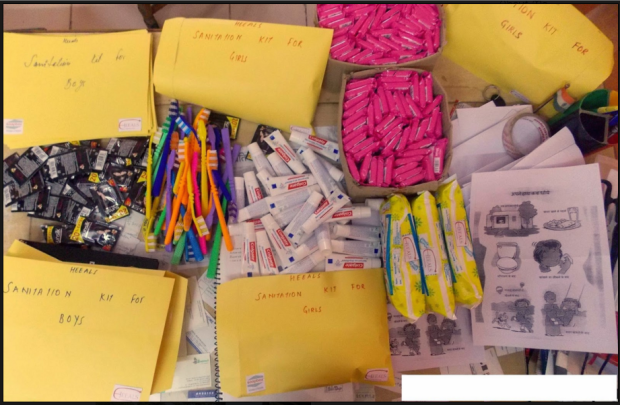
PHOTO: Some basic sanitation kits

*CONTENTS OF SANITATION KIT – the contents of sanitation kit will vary depending on funds and local demand

Sanitary items:
1 x soap bar
1 x sanitary pad pack
1 x toothpaste
1 x toothbrush
1 x mosquito coil
1 x hand sanitizer
1 x shampoo sachet
5 x WASH educational posters
1 x menstrual hygiene booklet (for girls)

Stationery:
1 x pencil
1 x pen
1 x eraser
1 x sharpener
1 x notebook
1 x envelope
tape
glue

A little goes a long way towards helping us! For just $1, you could supply a girl with enough pads to see her through her next period. For $9, the price of a cinema ticket, you could provide a child with a full sanitary kit for the next three months.
At the moment, we need just Rs 167000,00 / $2500 in order to fund WASH in Schools in the four schools identified for the project (reaching around 1,000 students).
All of the money raised on this crowdfunding page will godirectly to the project (including transport and logistics costs), and will allow us to impact the villages on a long-term basis by making sure that we not only carry out the project to its full extent, but are also able to return to the villages at a later date for monitoring and evaluation purposes.
If we do not raise the full $2500 of funding, we will do what we can with what the little we have and with the dedication of volunteers. For example by restricting our project to two schools instead of four. In the event of this scenario, our backers will of course be informed in detail about the changes, and will be provided with precise information about where their donation is going.


Some of our other work to raise awareness
                           
Films:
An End To the Darkness: Roshni Teaser:
Hand washing in the Himalayas:https://www.youtube.com/watch?v=M1VofggymC0
The Role of Sanitation in Menstrual Hygiene:https://vimeo.com/58771979

Press:
*“Dealing effectively with the water and sanitation crisis is fundamental to fighting disease and poverty.”:http://heeals.blogspot.in/2013/09/dealing-effec...
* SURVEY REPORT 2012 :
Other reports available upon request.

You can help us by many ways : by contributing financially to our project budget, then by spreading the word to your family and friends (sharing this page, or talking about our action), or even by volunteering!
Let’s meet on our website: http://heeals.org/ or Like our facebook page: https://www.facebook.com/Heeals or follow and tweet with us: https://twitter.com/heeals

THANKS FOR DONATING - HELP US MAKE A CHANGE
HELP US TO SPREAD THE WORD

Wednesday, 2 September 2015

UN health agency unveils sanitation and hygiene plan towards eradicating tropical diseases by 2020

27 August 2015 – The World Health Organization (WHO) today announced that it is strengthening water, sanitation and hygiene services to accelerate progress in eliminating and eradicating neglected tropical diseases by 2020 that affect more than 1 billion of the world’s poorest and most vulnerable populations.
“Millions suffer from devastating WASH [water, sanitation and hygiene] – related tropical diseases – such as soil-transmitted helminthiasis, guinea-worm disease, trachoma and schistosomiasis – all of which affect mainly children” said Dr. Maria Neira, WHO Director for Public Health, Environmental and Social Determinants of Health.
“Solutions exist, such as access to safe water, managing human excreta, improving hygiene, and enhancing targeted environmental management. Such improvements not only lead to improved health, but also reduce poverty,” Dr. Neira said in the WHO announcement.
WHO outlined a global plan to better integrate water, sanitation and hygiene (WASH) services with four other public health interventions to accelerate progress in eliminating and eradicating neglected tropical diseases by 2020.
“Targeted water and sanitation interventions are expected to bolster ongoing efforts in tackling 16 out of the 17 neglected tropical diseases, which affect more than 1 billion of the world’s poorest and most vulnerable populations,” according to WHO.
WHO also said that in 2015 more than 660 million people did not have access to improved water sources, almost 2.5 billion people lacked access to improved sanitation and more than 500,000 million lives are lost each year as a result of neglected tropical diseases.
Besides advocating for basic water, sanitation and hygiene, WHO uses four other key interventions in overcoming the global burden of the neglected tropical diseases. The four strategies are: preventive chemotherapy, innovative and intensified disease management, vector control and veterinary public health services.
The five-year agenda is in line with a World Health Assembly resolution, which calls for the formulation of a new, integrated WHO strategy including a specific focus on promotion of sanitation and hygiene behaviour.

Wednesday, 27 August 2014

Women relieving themselves in open face risk of rape: Government

("There is an immediate need…)
NEW DELHI: An overwhelming percentage of rural women who are forced to wait till nightfall to relieve themselves face the risk of being raped, the government has admitted ahead of a conference to review sanitation situation in the country.
"Sexual harassment and rape are a risk for many women who without a household toilet have to wait until nightfall to seek the privacy of darkness outside to relieve themselves," says the Centre's note on 'Swachh Bharat Mission' distributed to state ministers for discussion as they meet here tomorrow.
The note prepared by the Ministry of Drinking Water and Sanitation emphasised the need for sanitation, saying while having a toilet is important for everyone, access to safe, clean toilets brings particular benefits to women and girls.
"Freed from the need to defecate in the open, they no longer have to suffer the indignity, humiliation and often verbal and physical abuse when relieving themselves," it says.
The government says it becomes more traumatic for women during menstruation, pregnancy and postnatal periods.
"Women and girls don't need toilet facilities just for defecation; they also need privacy and dignity when menstruating. The need for sanitation facilities within homes and in public places, which meet women's physical and psychological demands cannot be over-emphasised," it says.
The Ministry has prepared the note after Prime Minister Narendra Modi, in his Independence Day speech, laid stress on "dignity of women" and pitched for making provisions for building toilets wherein women should not defecate in open.
The note says separate toilets at school mean more girls are likely to attend and continue even after puberty to complete their education.
"There is an immediate need to provide adequate number of toilets separately for boys and girls in all schools of the country," it says.
Noting that about 590 million persons in rural areas defecate in the open, the note says the mindset of a major portion of the population habituated to open defecation needs to be changed.
The Centre says many of the rural Indians already have a toilet but prefer to defecate in the open.
"The biggest challenge therefore is triggering behaviour change in vast section of rural population regarding need to use toilets. Changing mindset is very important," it says.
UNICEF reports indicate that it is the poorest quintile of the population which has the least access to sanitation.
"Inadequate access to water, sanitation and hygiene services keep children especially adolescent girls out of school, and keeps women in poor health and in poverty and destined to bear and raise children who are sick and nutritionally poor," UNICEF has said.
The Centre is vigorously pushing the agenda of sanitation to end the menace of open defecation in the country by 2019, the 150 birth anniversary of Mahatma Gandhi.
Source: The Economic Times
http://articles.economictimes.indiatimes.com/2014-08-24/news/53166748_1_defecation-sanitation-rural-women

Friday, 1 August 2014

Investing in health through hygiene

An improvement in sanitation and cleanliness will eliminate much of the difference in malnutrition between India and the rest of the world, and across Indian States

Historically the greatest advances in longevity and mortality reduction have come not from treatment of individual disease but from public health. This includes modern drainage and sewerage systems (sewage treatment plants), drinking water systems that produce and deliver disease-free water and solid waste disposal systems. The current position is illustrated by the low proportion of the population with access to improved sanitation facilities. The impact of this neglect is reflected in two well-known facts; one, ‘Delhi belly’ is infamous throughout the world and the Delhi middle class has to use water filters to protect itself from tap water-borne disease. And two, India is still home to communicable and vector borne diseases that have been eliminated in most countries outside sub-Saharan Africa.
According to the National Sample Survey of 2004-05, 1.9 per cent of Indian households defined themselves as hungry for some part of the year. Based on the same survey, the Planning Commission determined the proportion of poor according to the then prevailing national poverty line in 2004-05, which was between 21.8 per cent and 27.5 per cent. Malnutrition in children under three years of age as measured by the National Family health survey 2005-06 (NFHS 3) was much higher. Stunted and underweight children constituted 38.4 per cent and 45.9 per cent of children under three. The cross-State correlation between poverty rates and malnutrition rates was around 0.7 (using either Mixed Reference Period or Uniform Reference Period based estimates). At least 30 per cent of this cross-State variation in nutritional status of children was therefore totally uncorrelated with the variation of poverty rates across States.
Little improvement in malnutrition

The improvement in the nutrition status of children has also been disappointing. Over the seven years between 1998-99 and 2005-06, malnutrition has declined by only 1.1 per cent points while stunting has declined by 7.1 per cent points. This compares with a 4.3 per cent point decline in the poverty rate between 1999-2000 and 2004-05 (MRP). Though stunting has declined at a marginally faster annual rate (1.0 per cent) than poverty (0.9 per cent), the decline in the percentage of underweight children is minuscule. The implication is drawn that existing policies and programmes are not making a significant dent on malnutrition and need to be improved. To do this, however, we need to first find out what are the important factors responsible for malnutrition.
 Existing policies and programmes have not made a significant dent on malnutrition, and need to be improved 
Mixing up issues of hunger, average availability of food/cereals (or calorie deficiency), poverty and malnutrition, can lead to serious diagnostic errors and ineffective policies that make little dent on these problems. Virmani 2007 (Virmani, Arvind, The Sudoku of Growth, Poverty and Malnutrition: Lessons For Lagging States, Working Paper No. 2/2007-PC, Planning Commission, July 2007 http://planningcommission.nic.in/reports/wrkpapers/rpwpf.htm) concluded that the most important determinant of the variation of malnutrition across Indian States was public health deficiencies as measured by access to improved sanitation and drinking water. That is, the weakening of the absorptive capacity of the stomach due to gastrointestinal diseases and germs played a much more significant role in malnutrition than the availability of cereals which are the focus of the PDS system and ‘right to food’ advocates. The paper also suggested that basic public health information, nutritional knowledge and availability about nutritional foods may also play a role.
Das Gupta et al (Das Gupta, Monica, Rajendra Shukla, T.V. Somanathan, and K.K Datta, 2009. How Might India’s Public Health Systems be Strengthened? Washington DC: The World Bank Policy Research Working Paper 5140) argued that the fact that 25 per cent of stunted Indian children were in the highest wealth quintile reflected the burden of morbidity even among the affluent. WHO estimated that half of malnutrition is attributable to infections arising from poor sanitation, not lack of food.
There are three broad aspects of malnutrition that must be kept in mind when devising strategies for dealing with it. One, the ability to access such food items. This depends on household income or ability to sustain certain levels of consumption. The rate of poverty (head count ratio) is the standard indicator. Other possible indicators could include assets such as land and housing.
Two, household/family knowledge and information about good nutrition. This includes knowledge about the locally available foods that are good from the nutrition perspective. This can be based on,
(a) traditional age-old knowledge (old wives’ tales);
(b) ability to read, coupled with the availability of appropriate reading material on nutrition;
(c) access to media such as newspapers, radio and TV, coupled with propagation of such information on the radio; and
(d) special programmes such as ICDS that directly educate mothers about child-rearing and nutrition.
State of health

Three, the state of health. Even if the right kind of food and nutrition is available, a child may not be able to consume and/or absorb it properly due to ill health or sickness. For instance, a child suffering from diarrhoea much of the time is unlikely to be able to ingest much good and healthy food and absorb the nutrition, even if it is freely available and provided to the child by the mother/parents. Historically, it has been demonstrated across many countries that public health measures like clean drinking water, sanitation, sewerage, control of communicable and epidemic diseases and public health education play an important role in reducing mortality rates at every age and across gender. In the Indian environment, access to water and toilets, breast feeding (to impart immunity in an unhealthy environment), access to sound health advice/treatment, prevalence of vaccination and availability of vitamin supplements are possible indicators.
Virmani (2007) analysis showed that household access to toilets, breast-feeding of infants and vaccination of children has a significant effect in reducing child malnutrition. These variables explained 85 per cent of the cross-State variation in malnutrition. Nutrition variables were either not significant or had the opposite of the expected effect, indicating problems with the programmes. Expenditure on the Integrated Child Development Services (ICDS) appeared to have an uncertain effect, probably because it was effective in some States and not effective in others.
India is an outlier in terms of malnutrition in cross-country plots of malnutrition against per capita GDP. Correspondingly, India is way significantly worse than countries at its level of per capita GDP in terms of household access to toilets. It is however close to the trend line with respect to access to improved drinking water sources. Inadequacy of public health measures results in prevalence of gastro-intestinal infections (even if they do not manifest themselves in a visible disease or ill-health), that inhibit the absorption and use of food in the body. Even if enough food is available, the child may not be able to ingest or absorb it properly, resulting in under-nutrition.
Virmani 2012 (Virmani, Arvind, Undernourishment of Children: Causes of Cross-country Variation, Working paper No. WsWp 4/2012, October 2012 — Nutrition12oct.docx at https://sites.google.com/site/drarvindvirmani/) analysed the cross-country variation in child malnutrition. The quality of public health, as measured by variables such as access to better sanitation and improved water sources, is an important factor in explaining cross-country variations in the prevalence of malnutrition and inter-State variations across India. It also confirms the importance of primary education, particularly of females, in helping spread information and knowledge about personal hygiene, sanitation and nutrition. Much more could however be done through appropriate school curricula and media campaigns to promote public health education.
The analysis suggests that poverty is not an independent cause of malnutrition, but explains it to the extent that it is unrelated to unsanitary conditions. The proportion of adults having primary education also tends to reduce malnutrition. The primary completion rates for females is, however, more significant than for both male and female together, suggesting the relatively greater importance of female literacy.
Dean Spears and Lamba (2013), a village level study in India, showed the negative effect of open defecation on child stunting and wasting, thus confirming the importance of household access to toilets on the nutrition status of children (Spears, Dean and Sneh Lamba, Effects of Early-Life Exposure to Sanitation on Childhood Cognitive Skills: Evidence from India’s Total Sanitation Campaign, policy research Working Paper, 6659, World Bank, October 2013.) Jeffery Hammer et al have carried out micro-experiments that confirm these findings for the high income city of Delhi.
In conclusion, an improvement in sanitation and cleanliness as envisaged by the government’s “Swach Bharat” programme will eliminate much of the difference in malnutrition between India and the rest of the world and across the Indian States. The increased subsidies envisaged under the Food Security Act would reduce malnutrition more effectively if spent on sewers, sewage processing and garbage processing plants.
Source: The Hindu

A short documentary on the dowry system in india

Despite being illegal in India, dowry continues to affect thousands of families, contributing to financial stress, gender discrimination, do...